
How Words Shape Our Worldview: Language, Perception, and Meaning-Making.
Tânisi Kiya! (Hello, How are you!)
A friend recently taught me how to say hello in Cree (Tânisi Kiya). I’m on a quest to expand my vocabulary by incorporating more Indigenous languages into my lexicon. And in doing so, I’ve been reflecting on how the words we inherit shape the worlds we're able to imagine…
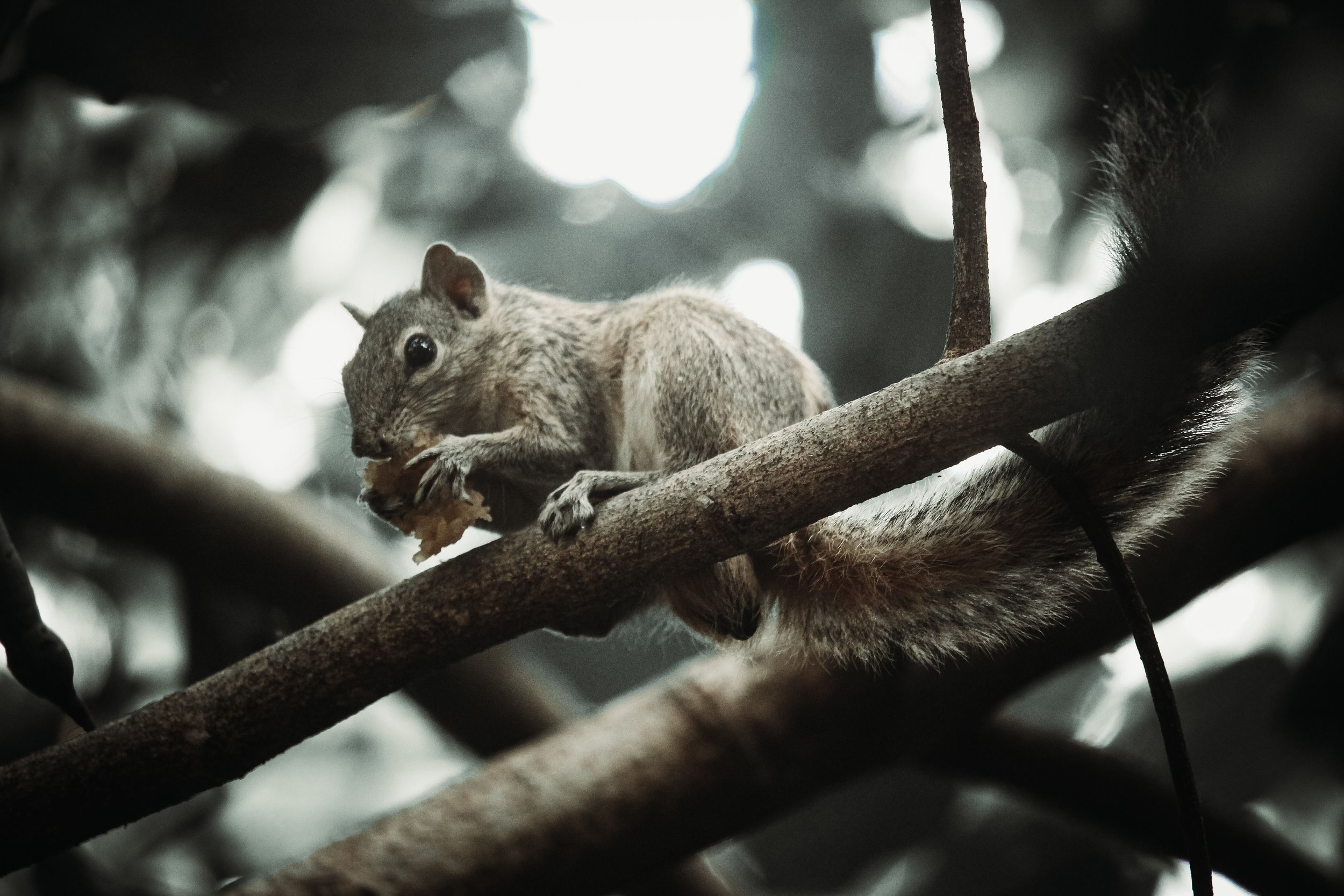
Say it slowly: skwur-uhl… "squirrel." Just air, tongue, and vibration we've all agreed means this creature.
Photo by JITHIN B on Pexels
We don't experience reality.
We experience our perception of reality, which is built from 3 main pieces: our current sensory experiences, our remembered past, and our present meaning-making.
Words are byproducts of that meaning-making.
Think of it this way:
I see a small creature scamper across a branch. I produce a combination of sounds:
skw — like "square" without the "are"
ɝ (ur)— the r-colored vowel in "her" or "nurse"
əl (uhl)— the soft "uhl" at the end
Say it slowly: skwɝəl… skwur-uhl… squirrel
and notice: it's just air, tongue, and vibration. Squirrel.
And because you and I have agreed on what those sounds point to, you know what I’m referring to. Even if the creature was not in front of us, you would know what I am saying because we have a consensus of meaning.
The sound is not the creature.
It is a metaphor for the creature.
And by expressing this combination of sounds—which we call a “word”, and which we have a agreed carries a meaning—a picture is painted in your mind based on either, what you currently see is the squirrel, or based on your past remembered experiences of squirrels in your life.
Words allow me to share something I experienced, even though you probably weren’t there. You can experience the moment through the words I share. And this can only happen because of a pre-establish consensus of meaning.
So let’s really think about this:
The words I choose begin to shape the experience you have.
Whether or not we share a consensus of meaning with a word, the meaning that word holds for you will color what you perceive. If I say the word pretty, you will perceive the experience, based on how you define what pretty is. And although we may have different ways of perceiving pretty, there is still a degree of consensus held within the word.
Now, if we put enough of these agreed-upon sounds together, we start shaping how we experience and interact with the world itself.
Which brings me to this crucial realization: we can only make further meaning with the words we have available to us!
Seeing it in the wild
1. Goluboy and siniy. Russian doesn't have one word for blue. It has two: голубой (goluboy) for lighter blues and синий (siniy) for darker blues — and Russian speakers treat them as entirely different colors. In a 2007 study published in the Proceedings of the National Academy of Sciences, researchers found that Russian speakers could discriminate between shades of blue faster than English speakers when the shades crossed the goluboy/siniy boundary. Same eyes. Same light. Different words — different perception. (Winawer et al., 2007)
2. A language with no "left." The Aboriginal Australian language Guugu Yimithirr, spoken in north Queensland, has no words for "left" or "right," "in front of" or "behind." Where we would use our own bodies as the reference point, its speakers use cardinal directions — always. As linguist Guy Deutscher describes in Through the Language Glass (2011), drawing on the research of John Haviland and Stephen Levinson: to make room on a car seat, you'd be told to "move a bit to the east." A warning might be to "look out for that big ant just north of your foot." Because the language requires it, its speakers develop an unfailing sense of orientation — a kind of perception most of us can't imagine, built entirely out of the words available.
3. "I am depressed" vs. "a heaviness is visiting me." Same feeling. Different world. The first makes it an identity — something you are. The second makes it a passing experience — something moving through. The words don't just describe the feeling; they shape what it becomes and what feels possible in response to it.
4. Eutierria. As some of you may already know, the word eutierria refers to the deep feeling of oneness with the Earth and its life forces. We didn’t have a word in the English language for that emotion until it was articulated by Glenn Albrecht. And by doing so we now have a way to communicate and express verbally when we are experiencing this emotion. My entire practice is named with a word that didn't exist until someone needed it to. When the available words aren't enough, we make new ones. And that, too, is meaning-making.
Why this matters
If we can only make meaning with the words we have, then the question becomes: whose words are we using? Colonial languages carry colonial worldviews inside them — hierarchies, separations, extractions baked into the vocabulary itself. To reach for different words—to reclaim, to invent, to borrow with respect—is how we make new perceptions possible. It's how we imagine worlds that the old words could never take us to.
This is just a preliminary exploration on the topic. I'm still inside it and may explore it more deeply later, but till then, I'd love to hear what comes up for you:
What words have shaped your world?
What experiences have you had that your available words can’t hold?
What words are you shaping? I’d love to know.
Uwarawarimo — May we grow together,
Javier
