
Growing up at the border of Texas and Mexico I constantly felt like I needed to defend or prove that I wasn’t Mexican or Mexican American. Both my parents are from Boriken (Puerto Rico) and I’ve always understood myself to be Borikua, but because I didn’t grow up on the island or in a Puerto Rican-centric disaporic environment, like Orlando or the Bronx, I felt disconnected. We were one of very few Puerto Rican families living on the border of Texas and Mexico, in a semi-arid desert, so very different from the tropical feels of the mother land.
My disconnection felt like I was never fully allowed to be who I was because people around me didn’t acknowledge or see me as who I understood myself to. For the most part, I didn’t think about it much because it just was my normal reality, but when the theme arose it would sting. Peers would be dismissive of my identity saying, “You don’t act or look Puerto Rican” or “You don’t sound Puerto Rican”.
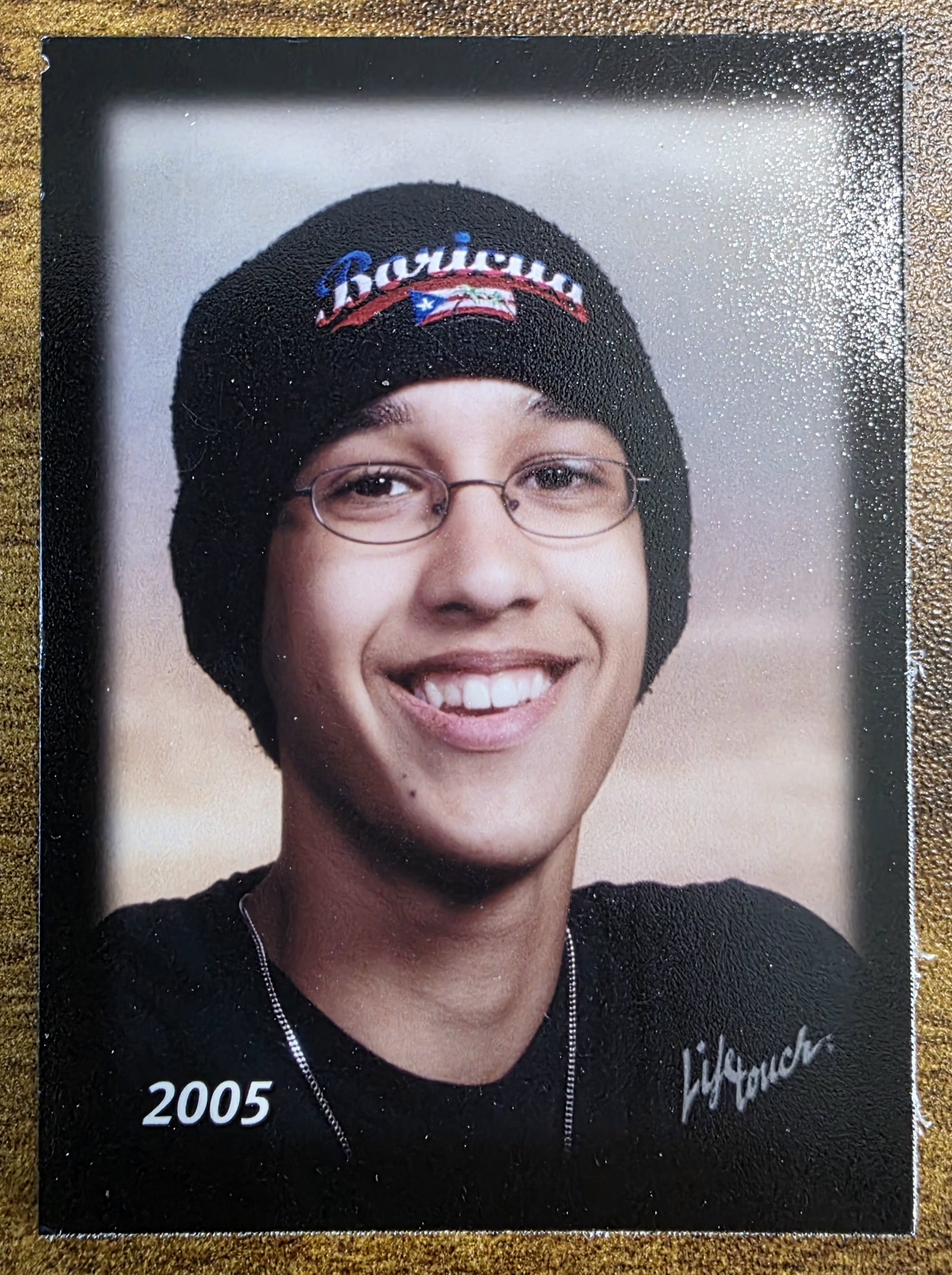
Me in high school, 2005, wearing my favorite beanie. I wore it a lot. It was one way I was able to remind myself of who I was in a world that told me I wasn’t.
So I started repping Borikua clothing: hat, shirt, beanie whatever I could find that said PR, Puerto Rico, Borikua or had the flag. The clothes felt like a statement. And I know it’s something pretty common that we as Borikua do in general. As a kid I didn’t know why we repped so hard, but it was a part of us. During my teenage years I had a favorite beanie that said “Boricua” on it. I wore it a lot. It made me feel like me! Like I know who I am and I want you to see who I am. I guess I was just longing to be recognized for who I was, who I am. For people to understand my story, my family’s story. So that we wouldn’t be so invisible.
Later I learned that the reason we wear clothing that reps where we come from has a history, and that helps me to put my beanie into perspective.
The Puerto Rican flag itself was born in the diaspora. On December 22, 1895, exiles in New York adopted it. After the United States took Puerto Rico in 1898, the flag was treated as a revolutionary provocation, and Nationalists carried it anyway. In 1948, the Gag Law made nationalist activity punishable by up to ten years in prison and a $10,000 fine, and in practice owning the flag was treated as evidence. In 1952, the same flag was adopted as the Commonwealth flag, with the blue darkened toward the blue on the United States flag. The Gag Law was repealed in 1957.
In the diaspora, the flag moved onto the body. The Young Lords in New York wore it on their heads, chest and hands, anywhere they could hang it. At the Puerto Rican Day Parade, which began in 1958.
I see that same need to be seen when I look at the parade today, and when I remember putting on that beanie as a teenager. I am not saying me wearing the beanie was the same as what the Young Lords were doing but I am saying that I was following in similar footsteps using clothing to say who I am when words alone were not enough to be seen.
My search for home started with spirituality, and that led me to a journey, kind of a mixed bag journey of experiencing Seventh-day Adventism. It was also a search for understanding myself, because I was, I am queer. When I had to finally come to terms with who I was based on my sexuality, it forced me to also have to wrestle with that spiritually, and I had to deconstruct my faith. I was asking the same question in both places: where can I belong as who I really am?
When that religious worldview fell away, I found refuge in the same way that I did when I was a teenager. I would go to nature, and nature was my refuge. I used to go out into the park and nature when I was a teen to kind of get away from home and get away from the stressors of family life. I would go to that park to dance. It was the combination of dancing and being in nature and having time to myself that helped me navigate the stressors from home. Unknowingly, as a teen, I was setting the tone for what I would practice years into the future.
Years later, I went back to that same combination. When I was dealing with the stressors of coming out and trying to embrace myself in the midst of losing my religious worldview, nature was what held me, and moving in nature was how I stayed in my body while my worldview was shifting. Going on backpacking trips, or just being out in nature in general, provided a space where I could reconnect, and it allowed me to connect more to myself.
Nature helped me to remember who I was, who I came from, and where I came from (the lands of my ancestors). Dancing had already taught me that freedom could live in my body, in nature, not just in my head, and that stayed with me as I developed a deeper relationship with nature. I learned how to interact with the elements of the natural world, especially while I was backpacking and dancing in nature.
There was a time in my life when I thought I could run away and escape from all the traumas and stressors I had grown up with. I used to think that a particular religious belief and path was going to provide all the answers and all the healing I needed. But overtime I learned that it was in nature that I found my healing. In nature, I learned that we are all expressions of Mother Earth. She shaped us as we are and she helped me realize that I didn’t need to run away. She invited me back home and she provided me a home. She showed me how to rebuild a sense of home by returning to my relationship with land and the land of my ancestors.
I saw that most clearly on a 30-mile backpacking trip I did solo. Out there, alone with the elements for miles at a time, I couldn’t run from myself, and I didn’t have to perform who I was for anyone else. I had to stay with myself, step by step, and let the land hold me. That is where I started learning, in my body, what responsibility to the earth and the land actually felt like. Out there, I was learning to trust my body in the same way dancing in the park had taught me to trust it as a teen, by moving with the land instead of running from it. “Coming home” was about learning I could stay, and be cared for, right where I was.
And so now, I’ve stepped into the responsibility of helping others to learn how to come home, to remember who they are, and to help them find strength and power in who they are.
What does that look like in practice? It looks like every morning starting my day with a contemplative practice, usually journaling, as a way of coming home to myself. It looks like spending time outdoors in nature everyday. It sometimes also looks like dancing in the mornings before I go to work, so that I start my day with joy, agency, and energy. These three practices I learned when I was a teen in high school and they’ve been a part of my life ever since. Dancing is how I cultivate my agency. Time in nature is where I learn about my relationship to the world, and journaling is where I learn about my relationship with myself. These three practices support my practice of mindfulness in how I live on and tend to the lands. Through these practices I learn how to be in better right relationship with all my relations.
I’m still learning and I’m still trying to unlearn and relearn how to value, know, be, and do better. And along the way I’m learning more about my heritage and the history of my ancestral lands, Boriken, and everything that our people have gone through historically. This journey has helped me to recognize that I have a role to play in this grand present day story that will one day be a part of history.
This is ever ongoing work. I am still learning, day by day, one day at a time, figuring out what I have to work on today and what I can let go of for now.
That daily returning is also how I keep despair from taking over. Not by pretending the disconnection and the wounds are not real, but by staying in relationship, with myself, with the land, with my ancestors, and with others, and choosing to build something better, day by day, moment by moment, piece by piece, together, not alone.
If you understand this journey, this disconnection from land and from culture, and you want to work with someone who gets it, there are two ways to do that with me. You can schedule a free discovery call to work with me in therapy, or don’t want clinical therapy you can join my virtual community Eutierria Connection, starting with monthly Re-membering Circle. Our next circle is Tuesday, December 8 at 6:00 PM Central. Either way, you don’t have to hold it all alone.
About the Author
Javier Omar Meléndez-Vega, LCSW-S, is a Borikua trauma-focused ecotherapist, clinical supervisor, and founder of Eutierria Therapy. Based in San Antonio, Texas, Javier offers land-based nature therapy locally as well as secure virtual telehealth throughout Texas and California. Drawing from Puerto Rican folk healing, somatic movement, and Indigenous relationality, he specializes in intergenerational trauma, eco-grief, capitalism fatigue, existential distress, and Ketamine-Assisted Psychotherapy for activists, healers, social workers, and socially conscious individuals. Learn more about his practice, clinical supervision, or schedule a free discovery call at EutierriaTherapy.com.
