
A Return to the Land and to Ourselves
San Antonio isn't like any other major city in the United States. There's no city like it in this country. San Antonio is defined by its vibrant culture, deep historic roots, and rapid, expanding growth. Some people even call it the most northern city of Mexico because of how beautifully proud this city is of it’s predominantly Mexican-American heritage, which shapes everything about how this city moves, eats, grieves, celebrates, and remembers.
This culture and history, is alive in the land, in the food, in the way families still gather, and in the way this region holds onto its roots even as it continues to expand and grow. There's something about San Antonio that makes it easy to feel embodied in the culture, in the history, in the earth itself. This land, this ecosystem, it's unique to here. It's not generic Texas. It's not generic anywhere.
But amidst the steady hum of 410 traffic, the rising desert-like temperatures, and the pressures of daily life within an urban environment, it's easy to lose access to all of that. It’s easy to feel disconnected from your body, your culture, and the earth all around you, even when it's right here, available to you.
Sitting by the waters at Woodlawn Lake Park, or walking the trails along Yanaguana, the San Antonio River, you can start to remember what that connection actually feels like. Or maybe you're just trying to get through a fast-paced work week, and your body's been holding tension for so long you've stopped noticing it's even there.
Growing up in the borderlands of Del Rio, Texas, I spent frequent time in North East San Antonio visiting family. Returning to live in San Antonio as an adult, after years outiside the state, has felt like a true return home, especially now that I have a deeper awareness of how land shapes us. Being here is teaching me how to cultivate a relationship with this place, how to be like this place, and how to learn from our local flora and fauna cousins.
This intentional relationship is the heart of Eutierria Therapy. The practice name Eutierria—a term coined by environmental philosopher Glenn A. Albrecht—captures a profound emotion: a deep feeling of oneness with the Earth and its life forces, where the boundaries between self and nature soften, and a sense of peace pervades consciousness.
I imagine when you spend late nights scrolling through online directories searching for a therapist in San Antonio, TX, the search itself can feel exhausting. Reading clinical profiles and trying to gauge whether someone "gets" you can make feel like you’re just a bundle of symptoms needing to be fixed. But you’re not a clinical file. You are a whole human being seeking genuine connection, space to breathe, and real alignment.
Choosing a therapist should be more than finding a convenient office location, because healing happens within a safe, collaborative, and trusting relationship. This guide is designed to clarify your options, demystify the search process, and empower you to find a therapist in San Antonio who honors your whole ecosystem: mind, body, spirit, land, and lineage.
Why Finding the "Right Fit" Matters:
Reclaiming Ourselves from Colonial Exhaustion and Capitalism Fatigue
Many people enter therapy after exhausting every standard avenue. You may have read the self-help books, tried podcasts, confided in close friends, or pushed through fatigue hoping the underlying anxiety would fade. But when systemic pressure, existential dread, and intergenerational trauma stack on top of one another, traditional "talk therapy" inside four fluorescent-lit walls can feel stifling—or worse, like just another form of pressure.
The main reason for that stifling feeling is that much of the exhaustion you carry isn't really a personal “you” problem—it's a structural problem. We live within the ongoing reality of coloniality and relentless capitalism. In this system, human worth is tied directly to output, monetary success, prestigious recognition, or endless, visible impact. The message we receive from this is constant: produce, perform, and prove your worth, with no finish line in sight. That’s the pressure we live with day in and day out, a pressure that lodges itself deep into our physical nervous systems.
I hear the weight of this from people every week:
"I feel like I'm in a black hole and can't stop crying."
"I'm backpedaling on my own core values just to keep up."
"I'm stuck in an endless loop—work, study, work, study—and I can't find the exit."
"The world feels like it's dying, but I'm supposed to pretend everything is fine and keep working my 9-to-5."
Underneath all of these experiences, what people are truly asking for is to reclaim their humanity and their freedom.
This is precisely why finding the right fit in a therapist matters so deeply. If a therapist doesn't understand coloniality or capitalism fatigue, their goal may subtly default to helping you cope with systemic harm just enough so you can return to being productive. They might treat your burnout as a personal failure of time management or resilience, rather than an intelligent response to a grinding machine.
My capacity to hold your grief, rage, and exhaustion comes directly from having to navigate this exact reclamation process in my own skin. I don’t try to sit in a clinical chair analyzing you from above; I walk alongside you as someone who has lived the painful architecture of colonial pressure and learned how to unmap it.
As a Borikua (Puerto Rican)—Taino and West African mixed with Spanish and Portuguese—colonizer and colonized converge within my own body. Born on a U.S. military base and raised in a Texas-Mexico border town, I learned early on what capitalism and coloniality demand of us: constant translation, code-switching, and shrinking into shapes that were never ours. Both fundamentalist religion and higher education asked for the exact same transaction: leave your body, stop dancing, trade what you feel for what you can perform, and hide your queer identity. That performance is the very definition of colonial exhaustion.
Reclaiming myself from that machine didn't happen overnight, but it showed me what true liberation requires. My reclamation process happened by refusing to stay in my head—by returning to my body through dance, finding my unapologetic voice through poetry, rebuilding a spirituality that didn't demand self-erasure, and spending long stretches of time on the land letting my nervous system remember it belongs to the earth, not to a 9-to-5.
I share this because your healing journey isn't a theoretical exercise to me; it is a lived return. At Eutierria Therapy, therapy steps away from colonial psychological frameworks that pathologize your survival responses, and instead steps towards Indigenous relational frameworks, which see your eco-grief, burnout, and capitalism fatigue as healthy, adaptive responses of a nervous system that cares deeply about life. The right therapist will not try to sanitize or silence that wisdom, but will walk with you as you guide yourself back home to your body, your roots, and the earth.
Navigating the San Antonio Therapy Landscape: Licenses & Credentials Defined
When searching for a therapist in San Antonio, you will immediately encounter an alphabet soup of acronyms after people's names: LCSW, LPC, LMFT, PsyD, PhD.
It’s easy to feel like you’re trying to decode a corporate directory. But understanding what these credentials mean—and what they don't mean—helps you separate state-mandated baselines from genuine therapeutic alignment.
In Texas, all of these licenses guarantee that a practitioner has completed a master's or doctoral degree, passed national examinations, and completed thousands of supervised clinical hours. They represent the state's baseline for legal and ethical consumer protection.
Here is what those letters mean in plain language, along with the specific lens each discipline brings:
LCSW / LCSW-S (Licensed Clinical Social Worker / Supervisor): Clinical social workers are trained to look beyond the individual brain. We view mental health through a systemic, environmental lens, examining how family dynamics, societal power structures, culture, and community impact your nervous system. An LCSW-S holds a supervisory designation, meaning they have met advanced clinical requirements to mentor and supervise the next generation of therapists.
LMFT (Licensed Marriage & Family Therapist): LMFTs specialize in relational systems. Their focus is on communication patterns, relational dynamics, and family structures, helping couples and families navigate conflict and generational cycles.
LPC / LPC-S (Licensed Professional Counselor / Supervisor): LPCs focus primarily on individual and group psychotherapy, utilizing varied psychological frameworks to help clients manage mental health symptoms, emotional distress, and life transitions.
Psychologist (PhD or PsyD): Psychologists hold doctoral degrees. In addition to providing psychotherapy, they are specially qualified to conduct standardized psychological testing, diagnostic evaluations, and clinical assessments.
Beyond the "Alphabet Soup": What the State Can't License
While licensure tells you that a clinician met the state's requirements to practice independently, a license cannot measure a therapist's capacity for relational safety, somatic attunement, or decolonial presence.
State licensing boards ensure ethical boundaries and clinical knowledge. But they were built within the very Western, institutional frameworks that often pathologize our survival responses. A license won't tell you:
Whether a therapist knows how to help your nervous system discharge stored trauma without forcing you back into your head.
Whether they understand that your burnout is a natural response to capitalism, rather than a personal failure of time management.
Whether they can sit with your cultural, ancestral, or queer identity without asking you to translate, justify, or perform.
Whether they honor the land as a co-facilitator of healing, or if they are bound strictly to four fluorescent-lit walls.
Licensure is the floor, not the ceiling. As you browse websites and directories in San Antonio, look past the alphabet soup to discover a practitioner's lived philosophy, their specialized post-graduate training, and, most importantly, how their words land in your body.
Traditional vs. Land-Based, Somatic, and Integrative Healing Approaches
Traditional talk therapy focuses heavily on cognitive understanding—analyzing thoughts, evaluating behaviors, and talking about your problems from the neck up. While intellectual clarity has its place, deeply stored trauma, systemic fatigue, and ancestral exhaustion live below the level of conscious, analytical thought. They lodge themselves in your tissues, your breath, your gut, and your nervous system.
If we want to unmap colonial exhaustion and heal from capitalism fatigue, we have to step outside of rigid clinical templates. At Eutierria Therapy, our work engages your whole ecosystem: body, land, lineage, and expanded states of consciousness.
Pathways of Embodied & Relational Healing
| Pathway | Core Focus | How It Facilitates Transformation |
|---|---|---|
| Nature-Based Ecotherapy | Land as an active co-facilitator | Moves therapy outdoors to engage local ecosystems, restoring kinship with place and non-human relatives. |
| Somatic Body Awareness | Nervous system & movement | Tracks physical sensation, breath, and movement to release trapped stress and ancestral grief from tissues. |
| Ancestral Honoring | Lineage & narrative medicine | Integrates cultural wisdom, story medicine, and folk practices to strip away colonial amnesia and reclaim identity. |
| Ketamine-Assisted Psychotherapy (KAP) | Expanded consciousness & integration | Serves as a neuroplastic catalyst to bypass cognitive defenses, move stagnant energy, and explore existential meaning. |
Nature-Based Ecotherapy: Stepping Out of the Four-Walled Box
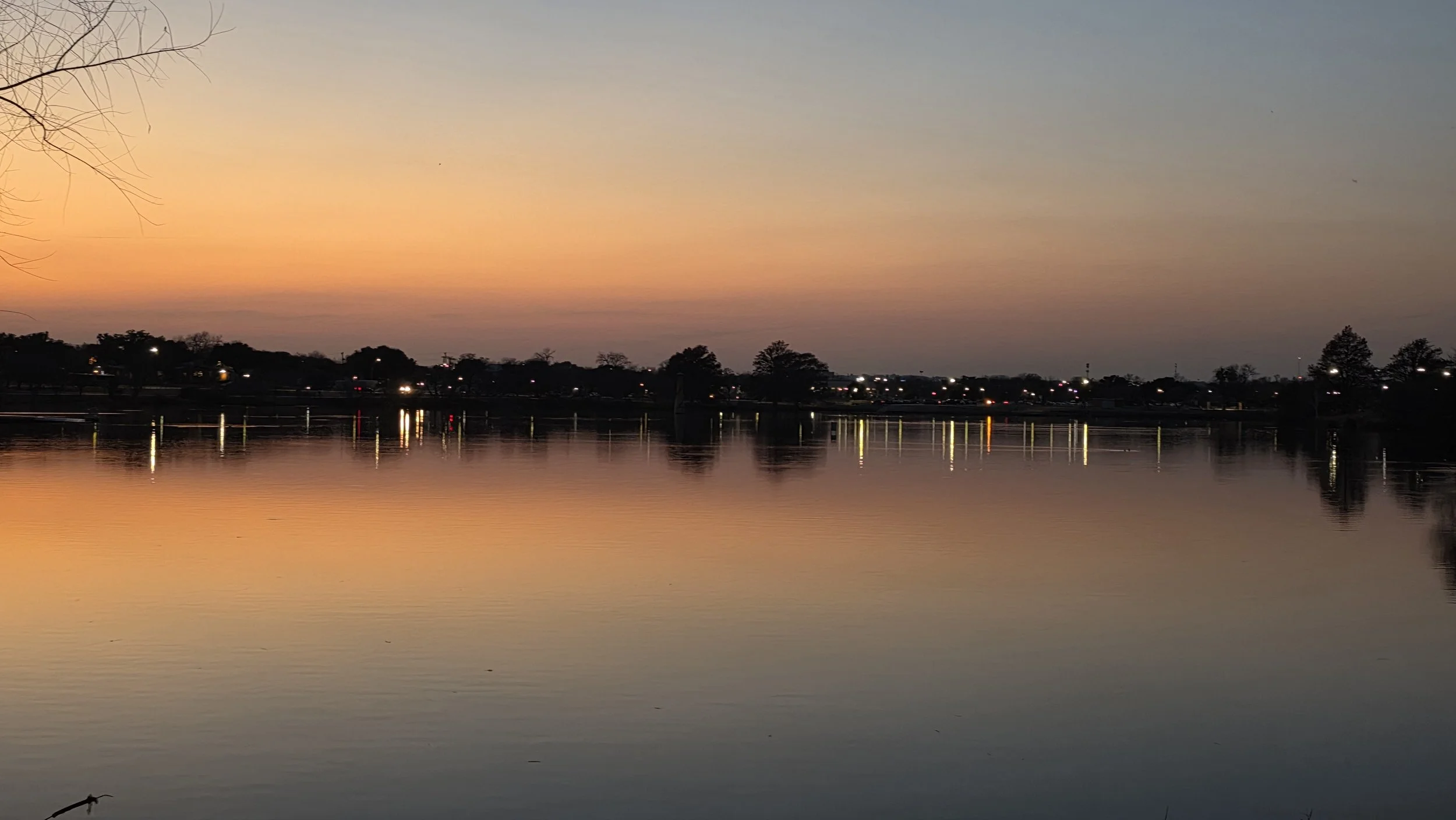
Woodlawn Lake in San Antonio, TX shortly after Sunset
My knowing that therapy belonged outside began long before I stepped into a clinical setting. Growing up along the Texas-Mexico border in a home impacted by intergenerational trauma, my refuge was the local park behind my house. Amidst the semi-arid heat, a heat that held me like a protective embrace, I would move, dance, and play outdoors, as way to release my heavy burdens.
When we step onto the land at local San Antonio spaces like Woodlawn Lake Park or O.P. Schnabel Park, our dynamic transforms from a top-down clinical assessment into a true kinship relationship. For us, the land is not a passive backdrop or a mere location; she is a living, sentient co-facilitator of healing.
By cultivating a relationship with the land, we learn how to "be like place"—learning from our local flora and fauna cousins. Earth becomes an active mirror for your internal state, a co-regulator for your nervous system, and a non-judgmental container that carries the weight of what you have been holding alone. Outside, you can drop the performative armor, breathe the warm Texas air, hear the hum of cicadas, and simply be.
Somatic Body Awareness: Unmapping Trauma from the Tissues
The body is neither a machine to be driven nor a problem to be solved. No, the body is nature herself.
Somatic therapy recognizes that your gut (yotoro*) and spirit (kahu*) hold a visceral awareness of truth, boundaries, and systemic violations. When you have spent years overriding your body to survive workplace demands, systemic discrimination, or family stress, your nervous system gets locked in chronic fight, flight, or freeze.
Instead of staying trapped in cognitive analysis, somatic work incorporates body awareness, breathwork, and gentle movement. We track physical sensations in real time, giving your nervous system permission to complete unfinished survival responses. By tuning into your bodily intuition, we move heavy stress, anger, and stagnant energy out of your tissues, restoring your sacred right to inhabit your body with calm and sovereignty.
Ancestral Honoring & Story Medicine
Colonialism relies on cultural erasure and colonial amnesia—teaching us to forget where we come from and severing us from the wisdom of our ancestors.
Drawing from Puerto Rican Folk Healing Practices (PRFHP) and Indigenous relationality, our work recognizes that cultural story, family memory, and ancestral traditions are profound forms of medicine. PRFHP honors the blending of healing traditions as a site of strength and resistance, viewing you as a complete whole: body, mind, spirit, culture, land, and community.
In our sessions, I bring the medicine and folk wisdom of my Borikua heritage into the container. But the goal is not for you to adopt my culture, it’s to use this relational space to help you uncover, reclaim, and activate the specific medicine of your ancestral lineage. By weaving narrative medicine and lineage awareness into our work, we put down inherited burdens and reconnect you to a deep, grounded sense of place and belonging.
Ketamine-Assisted Psychotherapy (KAP): Sacred Medicine Integration
For individuals navigating complex trauma, severe depression, or existential distress, Ketamine-Assisted Psychotherapy offers a safe, legal, and profound experiential path.
Across human history, Indigenous relatives and earth-based peoples across the globe have utilized altered states of consciousness as a normal, sacred practice for receiving guidance, understanding deep truth, and navigating life's transitions. KAP honors this ancient lineage by combining medicine work with intentional preparation, supported dosing containers, and thorough somatic integration.
Ketamine acts as a neuroplastic catalyst, temporarily softening defensive cognitive walls and quietening the chatter of the ego. This allows us to move stagnant energy and access insights that remain unreachable in ordinary states of waking consciousness. Beyond symptom relief, KAP opens a doorway into spiritual and emotional alchemy, allowing you to explore existential questions of meaning, purpose, life, and death, and guiding you deeper into an authentic understanding of who you are.
Our Relationality Framework: How We Work Together
Grounded in Indigenous ways of knowing (adapted from Tyson Yunkaporta’s Sand Talk), our work is structured around four sacred dimensions of relationality:
| Paradigm & Dimension | Core Question | Foundational Principle & Source | Guiding Value & Application | Dimension of Work |
|---|---|---|---|---|
|
Axiology Ways of Valuing Ayuanani Uma* |
What can we know? Tuei iyara wo aita?* |
All true knowledge is held within and defined by our commitments and connections to community, Ancestors, land, Law, and creation. |
1. Respect / Atuma* Enacted through intentional introductions, declaring shared expectations, and upholding sacred boundaries. |
Engages the realm of your spirit (kahu*) and your gut (yotoro*). |
|
Ontology Ways of Being Amani Uma* |
What do we know? Tuei anika wo aita?* |
Our fundamental purpose as custodians is to nourish and protect an intricate, deeply interconnected web of life. |
2. Connect / Adurawa* Fostering harmonious relationships and continuous loops of mutual give-and-take where all beings carry equal weight. |
Sensed and held through your heart (aniki*). |
|
Epistemology Ways of Knowing Aitani Uma* |
How do we know it? Halik'anika wo aita tura?* |
We interpret and make sense of reality through shared cultural metaphors, oral traditions, and narrative medicine. |
3. Reflect / Inamaya* Engaging in collective dialogue to construct a shared foundation of wisdom that directs our future path. |
Processed through the pattern-matching of your head (kaisimu*). |
|
Methodology Ways of Doing Anikani Uma* |
How do we work with that? Halik'anika wo kaudi oma tosa?* |
We put our wisdom into motion by continuously grounding, circulating, and evolving our community's guiding metaphors. |
4. Direct / Umayaru* Carrying out unified, collective action rooted in shared agreements and community-derived consensus. |
Executed through the physical labor of your hand (uhabu*). |
Framework Source: This structure is adapted from the 4-part relationality framework shared by Tyson Yunkaporta in Sand Talk: How Indigenous Thinking Can Save the World (2020).
* Note on Language: Terms marked with an asterisk are in Hiwatahia, a revitalized Taino language. I am actively learning and incorporating Hiwatahia into my daily speech, writing, and practice as an intentional act of decolonizing my mind and work.
Unmasking for Specific Communities: Dissolving the Artificial Borders
To survive within the dominant pillars of modernity—colonialism, capitalism, white-body supremacy, patriarchy, militarism, Christian hegemony, and the nation-state—many of us have been forced to wear masks.
We wear the mask of "professionalism," which so often acts as a quiet code for cultural assimilation, requiring us to silence our bodies, suppress our rage, and treat our natural grief or exhaustion as taboo. We wear the mask of stoicism to satisfy rigid expectations of masculinity, the mask of concealment to protect our queer love, or the mask of religious conformity that demands we shrink our true selves to be deemed moral or holy.
These masks function like nation-state borders drawn across a living landscape: they create artificial divisions between what is considered "acceptable" and what is not, what is "professional" and what is not, what is sacred and what is profane. They force us to divide ourselves internally, severing us from our innate wholeness.
At Eutierria Therapy, our relational approach is specifically designed to help you lay down these heavy, performative armors and step into a space where the boundaries between self, community, and nature can soften.
Who We Hold Space For:
Socially Conscious Practitioners, Organizers, & Artists: Those carrying systemic fatigue who need a confidential container where their rage, eco-grief, and exhaustion require zero justification or translation.
Therapists, Social Workers, & Healers: Clinical professionals who need a safe, non-judgmental space to shed the "unshakeable adult" armor, lay down secondary trauma, and step out of the mental health industrial complex.
Men’s Mental Health & Emotional Integration: Unpacking rigid social conditioning and patriarchal stoicism to reclaim vulnerability, emotional range, and authentic purpose.
LGBTQ+ & Queer-Affirming Care: Spaces free of explanation or defense, where queer identity, suppressed affection, and relational diversity are celebrated as natural expressions of life's infinite variety.
Religious Deconstruction & Spiritual Trauma: Processing fundamentalist harm, deconstructing Christian hegemony, and tending to your spiritual evolution without fear of judgment or erasure.
5 Practical Steps for Choosing a Therapist in San Antonio
Choosing a therapist is a sacred act of discernment. It is the process of choosing a relational container where your nervous system can safely put down its guard. Here are five intentional steps to help you navigate your search with clarity and somatic agency:
Clarify Your Intentions & Desired Alignment
Before scrolling through directories, take a quiet moment to check in with yourself. What is feeling heavy right now? Is it acute anxiety, intergenerational trauma, eco-grief, or deep capitalism fatigue? Write down not just the symptoms you are experiencing, but how you hope your life feels moving forward. Knowing what you need helps you filter for providers who can actually hold that depth.
Seek Systems-Informed and Culturally Safe Care
Ensure your potential provider recognizes that your stress, rage, or exhaustion are deeply tied to systemic pressures, coloniality, and white-body supremacy. Working with a systems-informed, anti-colonial practitioner saves you from having your natural, intelligent survival reactions pathologized as individual "mental illness."
Listen to Your Body While Browsing Websites
As you read therapist profiles, pay attention to how their words land physically in your body. Does your breath deepen? Do your shoulders drop? Do you feel a sense of spaciousness, or do you feel constricted by clinical jargon and cold diagnostic language? Trust your visceral intuition—your gut (yotoro) and heart (aniki)—over credentials alone.
Schedule a Discovery Consultation to Test Relational Alignment
Use the free 15-to-30-minute consultation call to interview the therapist. Pay attention to how they speak and listen: Do you feel unhurried, heard, and respected? How do they handle your questions about body-based, nature-informed, or decolonial care? Notice if the conversation feels like a collaborative dialogue or a top-down assessment. (Stay tuned for our upcoming guide on 7 questions to ask during your consultation).
Consider Format, Environment, and Accessibility
Decide which setting best supports your nervous system's regulation and your current lifestyle:
Outdoor Land-Based Care: In-person sessions in San Antonio green spaces where the earth acts as an active co-facilitator.
Secure Telehealth across Texas & California: Virtual care designed for flexibility while maintaining a somatic, ecological, and land-informed lens through the screen.
Group & Community Circles: Shared therapeutic containers built for collective processing, unmasking, and mutual care.
Frequently Asked Questions About Therapy in San Antonio
Do I have to sit in a traditional office for therapy?
No. At Eutierria Therapy, we take therapy out of the four-walled clinical box and onto the earth. We offer outdoor, land-based sessions in local San Antonio green spaces like Woodlawn Lake Park or O.P. Schnabel Park, where nature acts as a living co-facilitator to help ground your nervous system. For clients navigating chronic illness, busy schedules, or geographic distance, secure telehealth options are also available across Texas and California—maintaining an intentional, somatic, and ecological lens through the screen.
What is eco-grief or climate anxiety?
Eco-grief and climate anxiety are natural, intelligent emotional responses to planetary crisis, environmental destruction, and extreme weather shifts. Rather than pathologizing these feelings as individual anxiety disorders, ecotherapy validates them as proof that your nervous system cares deeply about life. Land-based work helps you honor this grief, process the underlying love it represents, and translate environmental overwhelm into grounded, collective resilience.
How does Ketamine-Assisted Psychotherapy (KAP) work in practice?
KAP pairs medicine work with intentional preparation, supported dosing containers, and thorough somatic integration. Drawing on ancient, cross-cultural traditions that utilized altered states of consciousness to receive guidance and move stagnant energy, KAP acts as a neuroplastic catalyst. It temporarily softens defensive cognitive walls, allowing us to process deeply stored trauma, heal systemic burnout, and explore spiritual or existential questions that remain unreachable in ordinary states of waking consciousness.
What does "decolonial therapy" mean?
Decolonial therapy—or anti-colonial therapy—is the deliberate process of unmapping systemic pressure, white-body supremacy, code-switching, and cultural erasure from your body. Traditional Western psychology often diagnoses survival responses as individual defects. Decolonial care shifts away from viewing you as "broken" toward cultivating somatic sovereignty—reclaiming your sacred right to inhabit your body, your lineage, and your ancestral truth without apology.
Taking the First Step Toward Reconnection
You do not have to carry the heavy, colonial isolation of believing you must hold the weight of the world alone. Healing is not about fixing a broken version of yourself or striving to meet the demands of an exhausting system. It is about remembering your inherent wholeness, softening the artificial boundaries of separation, and restoring your connection to body, community, lineage, and the earth.
Whether we walk side-by-side along the earth in San Antonio green spaces or connect across a virtual screen in Texas or California, this work will deeply ingrain a truth your nervous system has always known: you are not separate, and you are not defective. You are a sacred, indispensable part of a living web of relationships.
Ready to explore what rooted, integrative, and decolonial care feels like? Book a free discovery call with Eutierria Therapy today to ask questions, explore logistics, and take the next unhurried step on your path toward reconnection.
Author Bio
Javier Omar Meléndez-Vega, LCSW-S, is a Borikua trauma-focused ecotherapist, clinical supervisor, and founder of Eutierria Therapy. Based in San Antonio, Texas, Javier offers land-based nature therapy locally as well as secure virtual telehealth throughout Texas and California. Drawing from Puerto Rican folk healing, somatic movement, and Indigenous relationality, he specializes in intergenerational trauma, eco-grief, capitalism fatigue, existential distress, and Ketamine-Assisted Psychotherapy for activists, healers, social workers, and socially conscious individuals. Learn more about his practice, clinical supervision, or schedule a free discovery call at EutierriaTherapy.com.
———
*A quick note on these words: Throughout this piece, you may have noticed some words that were translated into Hiwatahia, which is a revitalized Taino language I am currently learning. Incorporating Hiwatahia into my writing and daily conversation is a conscious effort to decolonize my language and ground my practice in indigenous reclamation.
