
5 Common Myths About Therapy in San Antonio (and What Relational Care Actually Looks Like)
When considering support for your mental, emotional, or spiritual health in San Antonio, it’s completely normal to feel some hesitation.
Many of us—especially those of us raised in Latin American, borderland, or immigrant families—were brought up with strong cultural messages about mental healthcare. You may have been told that going to therapy means you’re "crazy," that you just need to pray harder, or that sharing your personal struggles with a stranger is a betrayal of your family's privacy.
Maybe you’ve tried therapy in the past, only to be met with cold clinical detachment from someone who gave endless CBT homework spreadsheets, or who dismissed your spiritual, cultural, or systemic realities.
In my Complete Guide to Finding the Right Therapist in San Antonio, we explored how standard Western healthcare often isolates distress inside the individual. But when therapy shifts away from rigid clinical tropes and moves into relational, land-based care, it stops being an intimidating evaluation and becomes a space of deep relief.
Here are 5 widespread myths about therapy—and what relational, earth-centered care actually offers instead.
Myth #1: "Therapists Just Listen, Nod, and Ask 'How Does That Make You Feel?'"
One of the most popular tropes of therapy is a clinician sitting silently with a blank, emotionless face, taking notes on a clipboard—maybe even doodling on it—while you lay on a couch pouring your heart out. Every once in a while, after a few passive nods and "uh-huhs," they chime in with the classic line: "And how does that make you feel?" It leaves you feeling like you're doing all the heavy lifting alone while a detached stranger observes you from above.
In my perspective, good therapy is an active, collaborative, and deeply human partnership. It’s a space where we engage in real, meaningful conversations about life talking about the everyday realities, cultural structures, and societal systems you navigate every single day.
As a Borikua practitioner who walks through the ongoing realities of code-switching, religious deconstruction, and ancestral reclamation, I aim to walk alongside you as someone who understands what it means to navigate complex terrain.
Together, we pause and check in, guiding a self-reflection process that connects your thoughts and emotions to what’s happening in your body, spirit, culture, and community. In Eutierria Therapy we may meet virtually or even outdoors connecting with the land in local San Antonio green spaces. We use story, narrative, and metaphor to help you process the struggles of life without ever pathologizing your humanity.
Myth #2: "You have to be 'broken' or in crisis to go to therapy."
We usually think about going to the doctor only when we feel sick or when something is visibly wrong with us. That’s because traditional Western healthcare operates on a rigid disease model centered around pathology—a framework that asks, "What's wrong with you?" and treats care as something you only seek when a system has completely broken down.
Healthcare doesn't have to look like that.
Instead of waiting for a collapse, therapy can focus on what actually cultivates and expands wellness in your life. In my practice, care centers around promoting living well—looking at where we can enhance your vitality, balance, and daily experience of peace. To guide this, I often draw from The Seven Circles: Indigenous Teachings for Living Well by Chelsea Luger and Thosh Collins, using their wholistic* framework to explore how wellness touches every interconnected part of your life.
This also means we don't treat your distress as an individual defect. Operating on a constant "high-alert stance," feeling your brain "on fire" from workplace demands, or carrying the heavy background dread of global crises are not signs that you are broken. They are intelligent, healthy responses of a nervous system trying to survive in an unsustainable world.
While therapy is certainly a supportive container during times of acute crisis, you don't have to wait until you are in physical or emotional collapse to seek care. You can step into therapy simply because you want to explore what it means to live well, shift what needs shifting, and cultivate more wellness in your everyday life.
Myth #3: "I should be able to handle this on my own."
If needing help makes you feel weak, undisciplined, or like a personal failure, you're not alone. So many of us—especially those who act as the steady anchor for our families, workplaces, or communities—have been conditioned to believe that carrying everything by ourselves is a badge of honor.
That belief is a myth born out of Western hyper-individualism. It’s a lie that isolates us and makes us feel broken when we hit our limit.
The truth is that as human beings, we are deeply social creatures. We didn't evolve to survive in isolation, and there is actually no such thing as being "on your own." We live in an interconnected web of relationships on this planet—a closed system where everything is related, and what happens in one part of the web ripples out and touches the rest. Needing others isn't a flaw in your character; it's basic ecology.
Nobody achieves healing, growth, or survival all by themselves. Part of our work in therapy is to unlearn the lie of isolation and remember how to be in relationship again.
Therapy offers a grounded space where you can practice laying down the armor and realize you don't have to carry the weight of the world alone. And if you feel like you have to do everything by yourself because you currently lack a supportive village, that is all the more reason to seek support. Together, we can work on rebuilding that sense of connection and strengthening your community ties—because healing was always meant to happen in relationship.
Myth #4: "A therapist will judge your culture, dismiss your spirituality, or pathologize your identity."
To be completely honest, this fear may not be an irrational myth, because it does come from a very real, historical truth.
For BIPOC, queer, trans, and spiritually deconstructing folks, the hesitation to enter clinical spaces is a healthy self-protective response. Mainstream psychology and medical systems were historically built within Eurocentric, white-centric frameworks—largely developed by white men—that treated Western scientific logic as the only valid way to understand truth. Under this worldview, cultural practices, spiritual realities, ancestral ways of knowing, and systemic grief & rage have frequently been pathologized, labeled as disorders, or dismissed as "irrational."
That history of structural medical harm is real, and it’s why so many people feel the need to sanitize, defend, or translate themselves the second they step into a therapist’s office.
While those systemic patterns still exist in healthcare today, there are practitioners who actively work to unmap and challenge them. I aim to be one of those practitioners.
In my practice, we don't start from a Eurocentric baseline that treats your culture or spirituality as an afterthought or a diagnostic symptom. I draw from my own lived experience, Puerto Rican folk traditions, and Indigenous relationality frameworks. I aim to hold your cultural heritage, spiritual evolution, and unique worldview as foundational sources of wisdom and truth so you don't have to defend your story or hide your ancestral practices. Together, we create a space for your identity to be held with deep dignity, and I support you in tapping into your own ancestral and personal wisdom to heal on your own terms.
Myth #5: "Therapy is just paid venting with no real tools or direction."
If therapy is just paying someone once a week to listen to you vent, then why not just vent to a friend or a journal for free? Honestly, if you're going to therapy just to vent and your therapist is letting you do that endlessly without any direction, that isn't really therapy—and it isn't going to get you very far.
Venting can feel good in the moment, but talking alone is rarely what brings deep healing. When we navigate trauma, burnout, or systemic stress, heavy emotional and psychic energy gets physically trapped in our nervous system. You can talk around your problems for hours, express all your anger, and still walk away with that lingering, heavy feeling stuck in your chest or body because the energy hasn't actually moved.
In my practice, therapy is an active, collaborative partnership where we both do the work to create real shifts in your life. It requires a much more directive approach where we actually engage in practical, hands-on tools—things like grounding, breathwork, body movement, vocal toning, art, sensory touchpoints, and direct connection with the land to help move and discharge that stuck energy.
We call them "practices" because they require actual practice. Healing isn't just something that happens during our session time; if you aren't engaging with these tools in your everyday life between meetings, it’s no different than just venting. Real transformation happens when you actively practice the ways of being you want to embody, using real-world tools that build your independence and help you return to living.
Stepping Out of the Myths and Into Relational Healing
If you’ve held onto any of these hesitations, know that it’s completely normal. It’s your nervous system’s intelligent and healthy way of protecting you from cold, pathologizing, clinical environments that were never built to hold the full depth of your humanity.
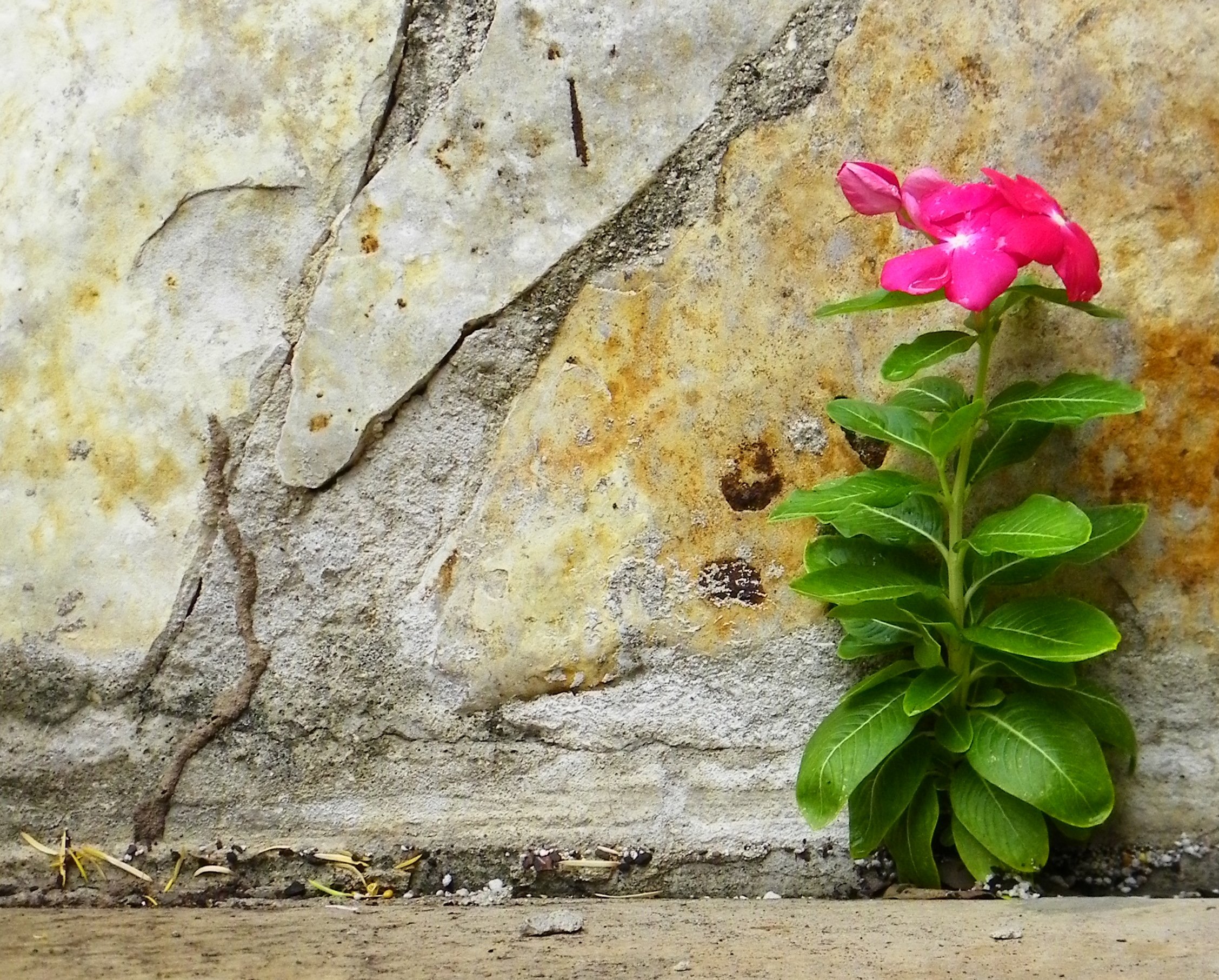
Pink impatien flower growing between the concrete floor and rock wall of my childhood home.
Healing isn’t about fixing a “broken” version of yourself, because there’s nothing “broken” about you. True care is a collaborative partnership where we honor your lineage and cultural story, move stuck energy through body- and land-based practices, and give your nervous system permission to lay down its heavy armor. You don't have to navigate systemic burnout, cultural isolation, or life transitions alone.
When we step out of rigid clinical tropes, therapy becomes what it was always meant to be: a grounded, relational sanctuary that supports you in returning to yourself, restoring your connection to the web around you, and stepping back into the joy of living.
Ready to Explore Relational Care in San Antonio?
Whether you are looking to step onto the land for 90-minute nature sessions in San Antonio green spaces, explore relational Ketamine-Assisted Psychotherapy, or connect through secure virtual telehealth across Texas and California, you don't have to compromise your dignity or culture to receive deeply rooted care.
Schedule a free discovery call with Eutierria Therapy today to ask questions, explore our virtual or land-based options, and see what relational, body-centered care feels like for you.
Author Bio
Javier Omar Meléndez-Vega, LCSW-S, is a Borikua trauma-focused ecotherapist, clinical supervisor, and founder of Eutierria Therapy. Based in San Antonio, Texas, Javier provides outdoor, land-based nature therapy locally as well as secure virtual telehealth throughout Texas and California. Drawing from Puerto Rican folk traditions, somatic processing, outdoor leadership, and Indigenous relationality, he specializes in intergenerational trauma, religious deconstruction, systemic burnout, existential distress, and Ketamine-Assisted Psychotherapy for activists, healers, social workers, and socially conscious individuals. Learn more or schedule a free discovery call at Eutierriatherapy.com/contact.
———
*A note on spelling: I intentionally spell wholistic with a "W." Inspired by Indigenous scholars Renee Linklater (Rainy River First Nations) and Alice Olsen Williams (Curve Lake First Nation), this spelling represents true wholeness and inclusivity. It deliberately moves away from the root word "holy," which carries patriarchal power and specific religious connotations (Linklater, 2021). This inherent wholeness connects the individual directly to the collective.As psychologist Arthur W. Blume notes, "A truly [wholistic] approach to professional psychology would feature simultaneous effort to heal and empower individuals, their families, the larger social order, and the global community simultaneously by addressing both micro-level and macro-level psychological concerns," (Blume, 2020)
